Part 4: IP Strategy — Patents and Software Licensing (Pitfalls Such as AGPL)

Part 4 is about intellectual property. For medical AI web services, a comprehensive strategy that includes not only patents but also software licensing is essential.
The Patent Perspective
- Patents for algorithms/SaMD, FTO (Freedom to Operate) searches, and design-arounds.
- The treatment of software patents differs by country and requirements, and there are many areas that cannot be fully protected by patents alone.
The Software License Perspective (Important)
Medical web services depend on numerous OSS, models, and data. Key licenses and their constraints:
| License | Type | Main Constraints / Cautions |
|---|---|---|
| MIT / BSD-2/3 / ISC | Permissive | Preserve the copyright notice. Few constraints, easy to use commercially |
| Apache-2.0 | Permissive + Patent Grant | Explicit patent grant. Preserve NOTICE. Termination clause in case of patent litigation |
| MPL-2.0 | Weak copyleft (per file) | Disclosure of modified files. Unlikely to extend to the entire application |
| LGPL-2.1/3.0 | Weak copyleft (library) | Centered on dynamic linking. Ensuring replaceability |
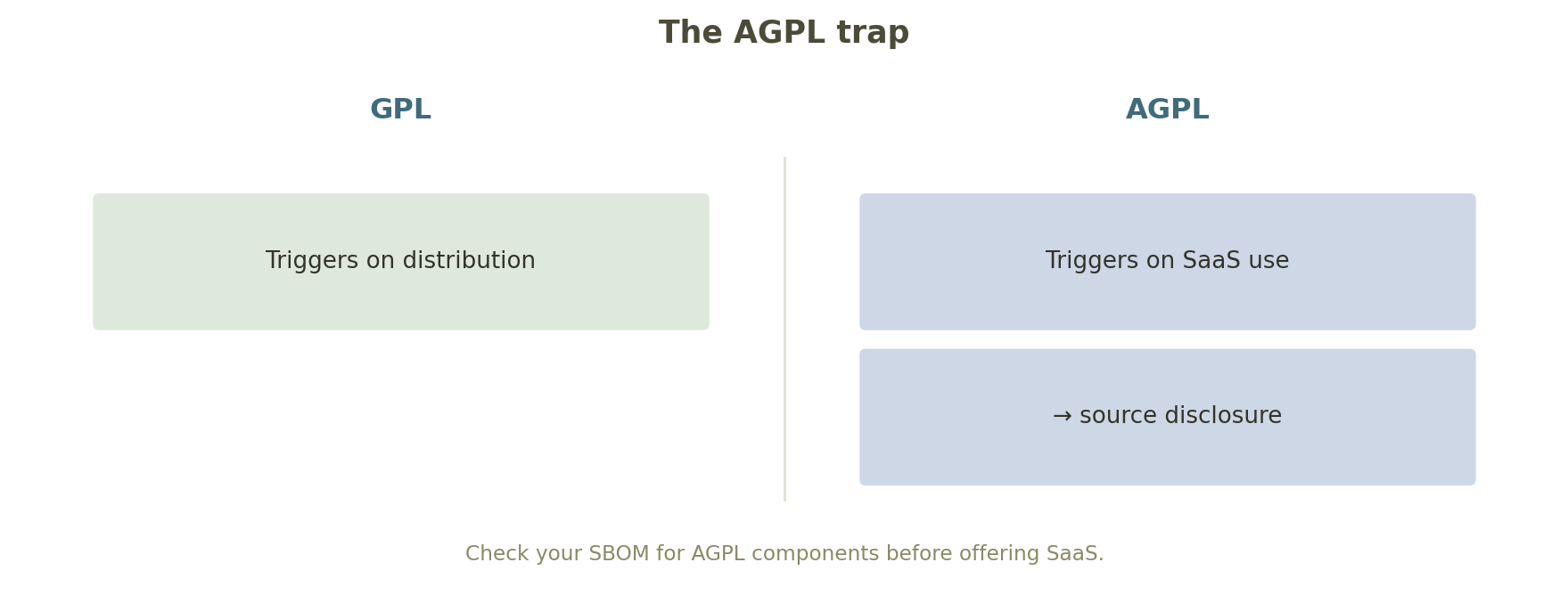
| GPL-2.0/3.0 | Strong copyleft | Source disclosure upon distribution. GPL3 has a patent clause |
| AGPL-3.0 | Strong copyleft + Network Clause | Even merely "letting users use" via SaaS triggers a source disclosure obligation. The most critical caution for medical web services |
| Commercial / Proprietary | Closed | Individually verify terms of use, scope of use, and redistribution restrictions |
| Dual License | Selectable | OSS version and commercial version (also note derivatives such as the SSPL family, e.g., MongoDB) |
| Model/Data type (OpenRAIL, Llama Community, CC family) | Individual | Note commercial use / use-case (medical) restrictions, redistribution, and handling of outputs |
Network Clause (the core of AGPL): Section 13 of AGPL-3.0 imposes an obligation to provide source code access to users who interact with a modified version over a network. The SSPL (used by MongoDB, etc.) is based on a similar concept.
SBOM (Software Bill of Materials): A list of all OSS components, versions, and licenses. The key is to identify all dependencies, including transitive dependencies.
Why a "Comprehensive Strategy" Is Essential
- The network clauses of AGPL/SSPL can trigger a source disclosure obligation the moment you publish as a web service—if they sneak into your dependencies, they can shake your business model.
- The license of the model weights (commercial viability, medical-use restrictions) determines whether the service is viable.
- License selection, such as the patent grant of Apache-2.0, is also directly linked to patent risk.
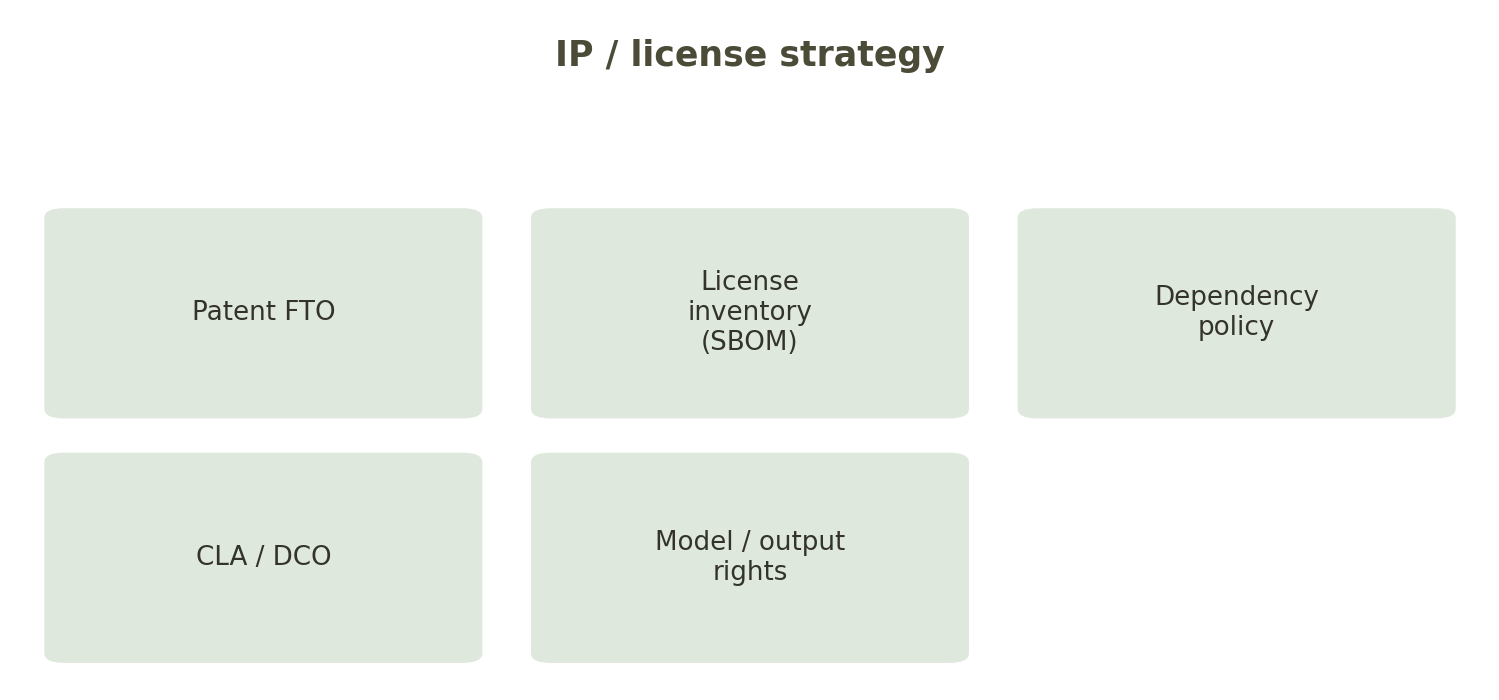
- Therefore, you need to design a programming strategy from the very beginning—including a license inventory (SBOM), dependency policy, contributor agreements (CLA/DCO), and organization of rights to outputs/models (retrofitting is high-cost and high-risk).
Shishido & Associates provides advice that spans patents + licensing + AI implementation (an operational approach that separates confidential and public assets, like [[big-files-local-store]], is also important). In the next article (Part 5), we will provide comprehensive answers to the five questions posed in Part 1.
![Why Only a "Handful of Companies" Reaped Enormous Profits from mRNA Vaccines —— How Patent Strategy Decided Pharmaceutical Supremacy [Paid]](/static/images/blog/ai/mrna-dominant-design.png)