Play the pedal with your head.
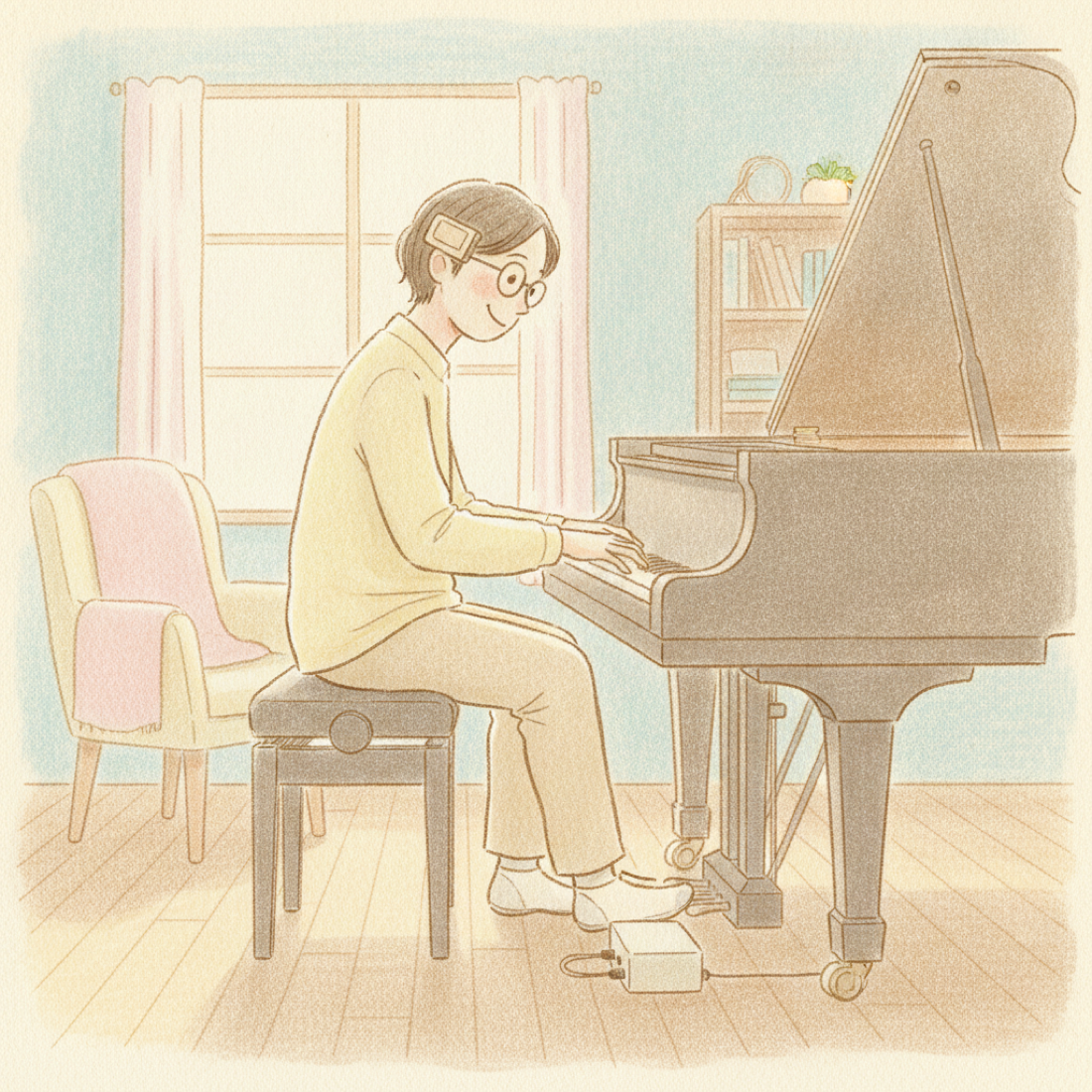
bFaaaP is an AI assistive system that lets a pianist sustain notes without using a foot pedal. An iPhone reads the player's head angle with AI (ARKit / TrueDepth) and sends it over Bluetooth Low Energy to a device that operates the piano's sustain pedal — so people with limb differences, small children and the elderly can play more fully. After years as a product, bFaaaP is now an open-source project: iOS app, firmware, hardware and docs.
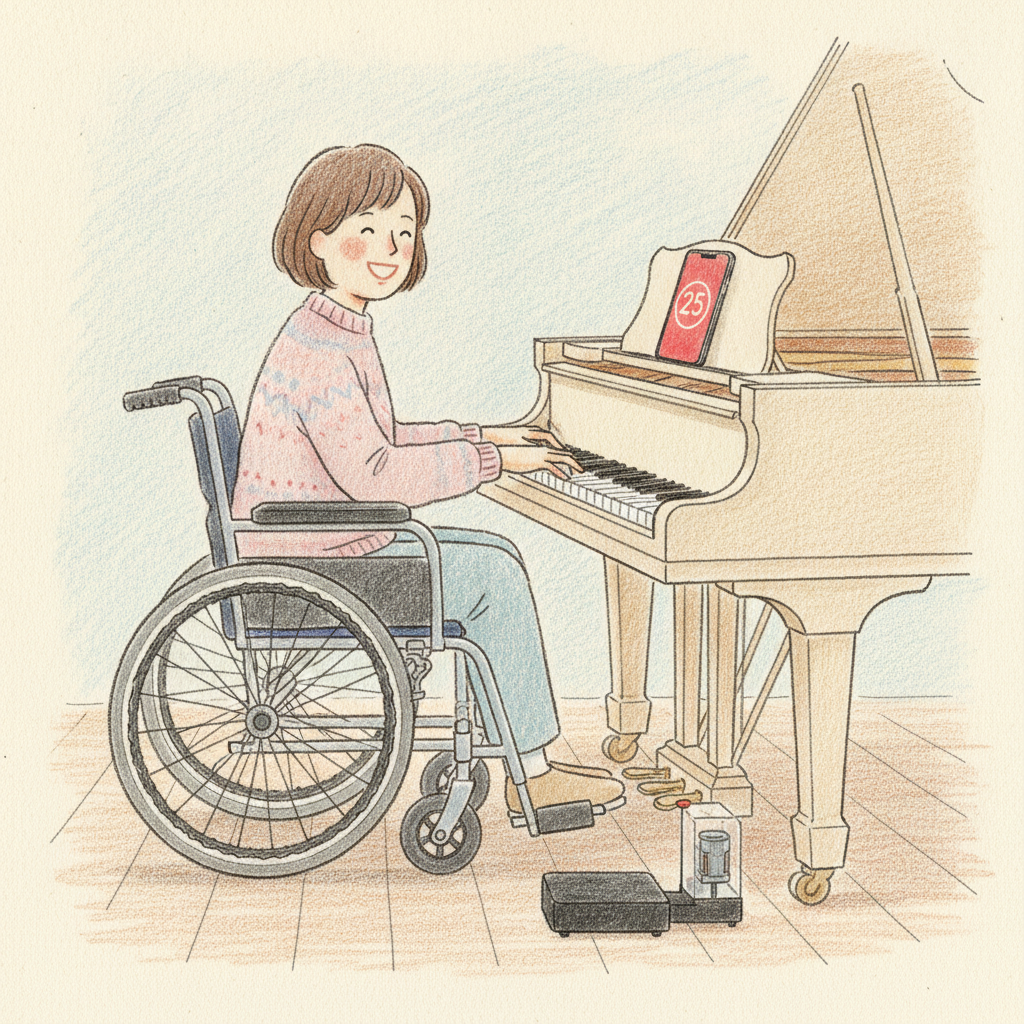
The bFaaaP website — bfaaap.com
The bFaaaP Open Source Project has its own website, bfaaap.com (in English, 日本語 and Deutsch). It walks you through the project's story, how it works, how to build it yourself (iOS app, Switch, Pro), messages from members and musicians, and even the "Live theater" of the AI and the team building it together — all with friendly illustrations and diagrams.

Support the bFaaaP Open Source Project
Your support goes mainly to AI build-support, so anyone can make bFaaaP. We gather questions raised on GitHub Discussions every day and draft answers with AI, grounded in bFaaaP's primary sources (schematics, circuit diagrams, code) — so anyone can reproduce and adapt the software and hardware themselves (funds cover API costs, curating the sources, and maintenance).
Pro for acoustic, Switch for electric
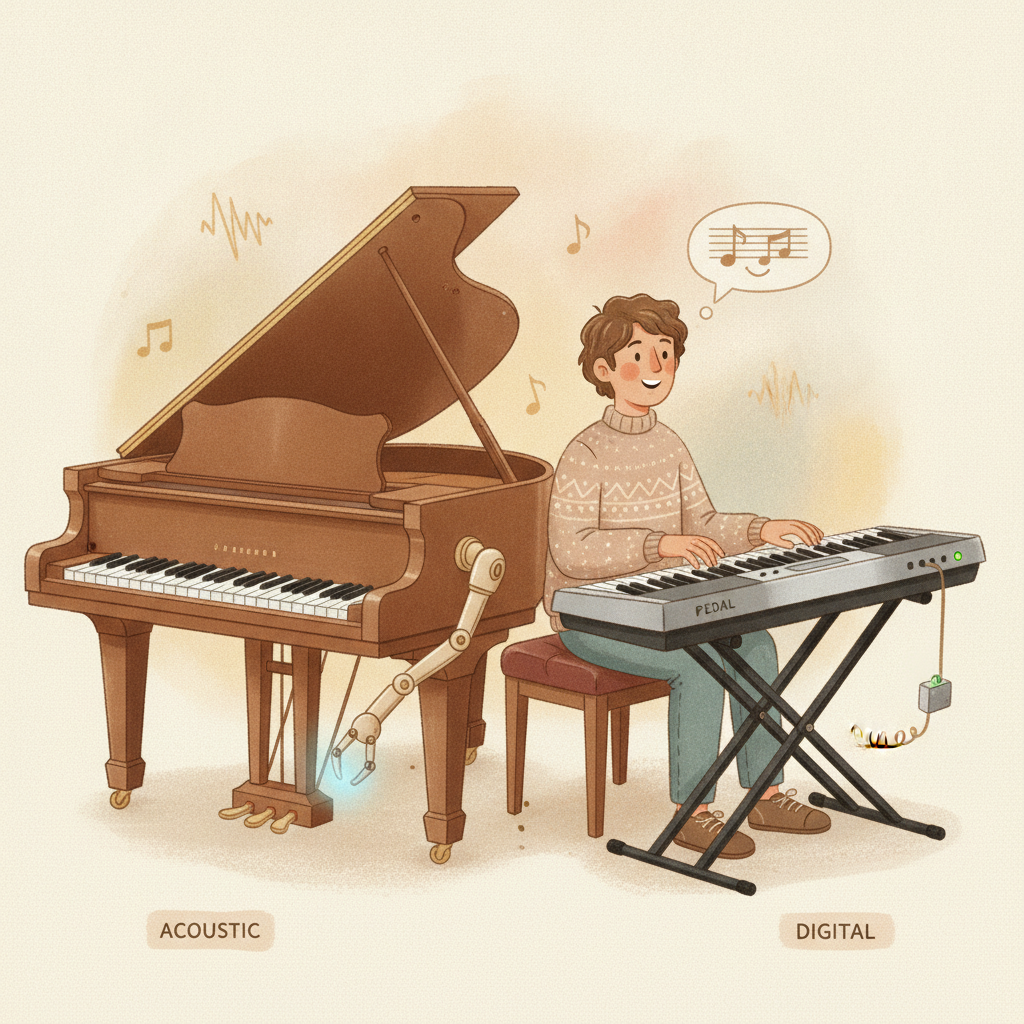
bFaaaP Pro
Acoustic pianos (grand & upright)
A motorized device that physically presses the sustain pedal in proportion to your head angle. A servo drives a belt → lead-screw → push-rod, anchored with an air-jack kit — no modification to the piano.
bFaaaP Switch
Electric pianos & keyboards
A small BLE unit that plugs into the digital piano's sustain-pedal jack (6.3 mm) and acts as an electronic switch — no motor needed. Supports both on-type and off-type sustain logic. (Japan radio cert. 技適 R018-180280.)
How it works
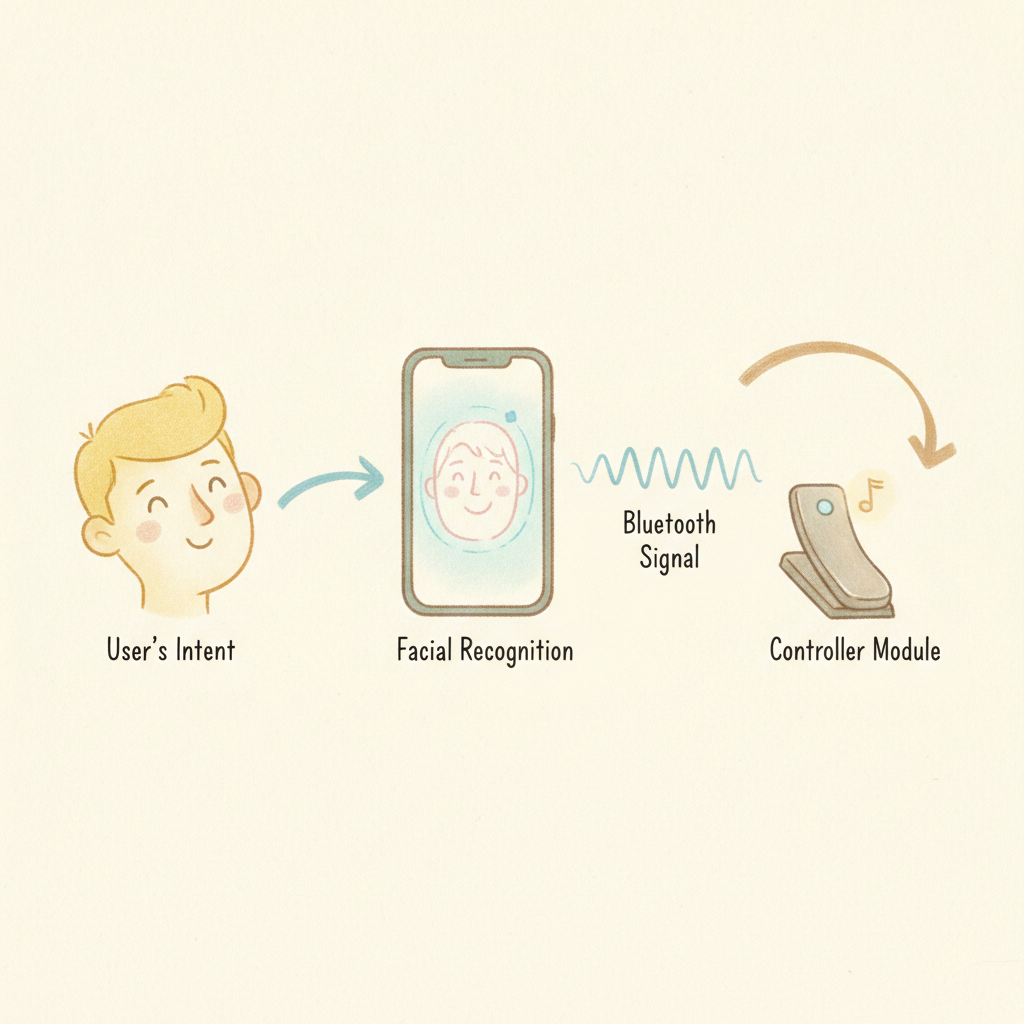
1 · Head-angle sensing
The iOS app uses ARKit face tracking (TrueDepth) to read your head pitch, scales it by a user-set multiplier, and clamps it to a 0–99 value — all on-device.
2 · BLE to the device
The value is streamed over the Nordic UART BLE service (engage N / release F / level iNN) to the pedal device, which presses (Pro) or switches (Switch) accordingly.
3 · The timing trick
Surprisingly, ARKit produces head angles (~60 fps) faster than BLE can transmit. Sending every frame floods the link. bFaaaP therefore samples instead of streams: AR writes the latest angle into a shared variable, and a separate 100 ms timer paces the radio (~10 Hz). This one decision is the backbone of its stability.
bFaaaPSwitch_1…4) avoids connecting to the wrong Bluetooth device. iOS 14.5+, iPhone/iPad with TrueDepth; Swift + ARKit + CoreBluetooth.The “key” to the patent — turning intent into natural playing
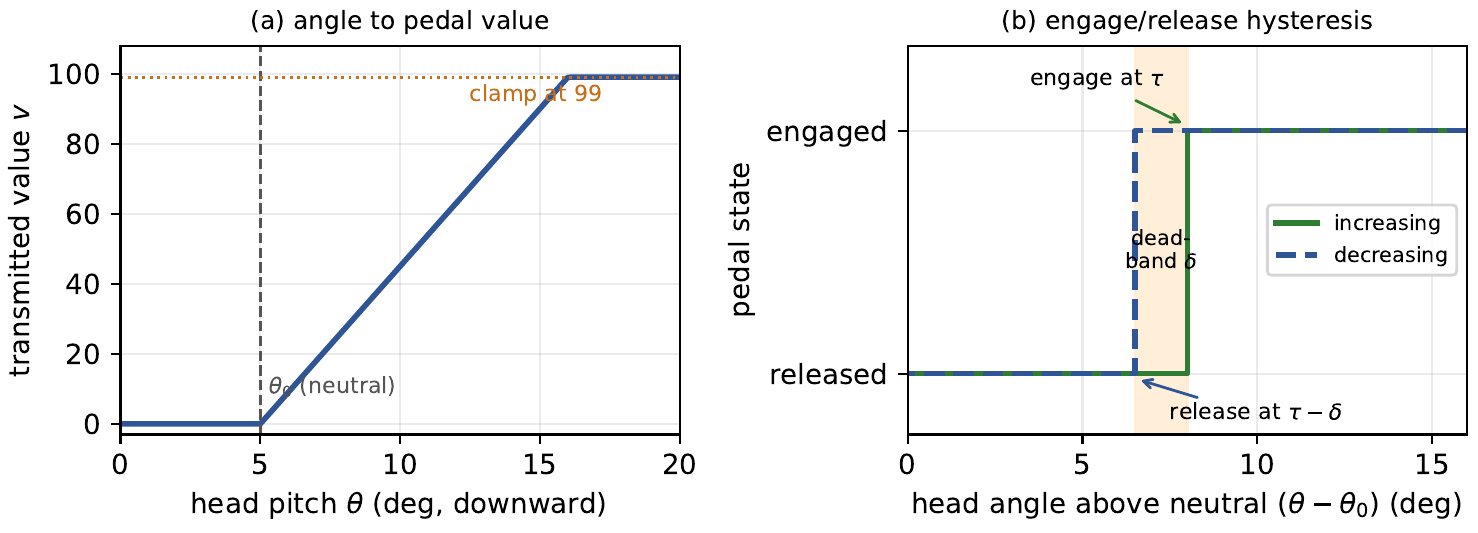
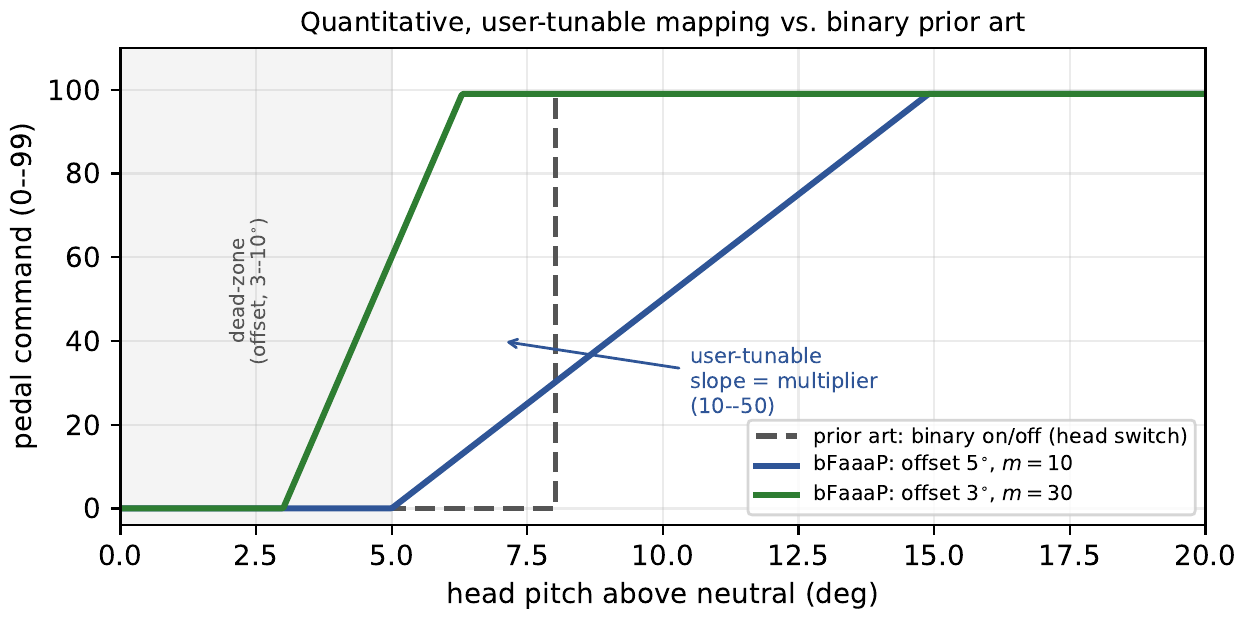
bFaaaP is not a crude on/off. The player presets a threshold (offset) and a multiplier; together these two fix how fast the pedal follows the head past the dead-zone (the response speed), so the device reproduces the player’s own intended, natural pedalling. The bare head→pedal idea was already known — it is this specific, tunable control law that the patents were granted on.
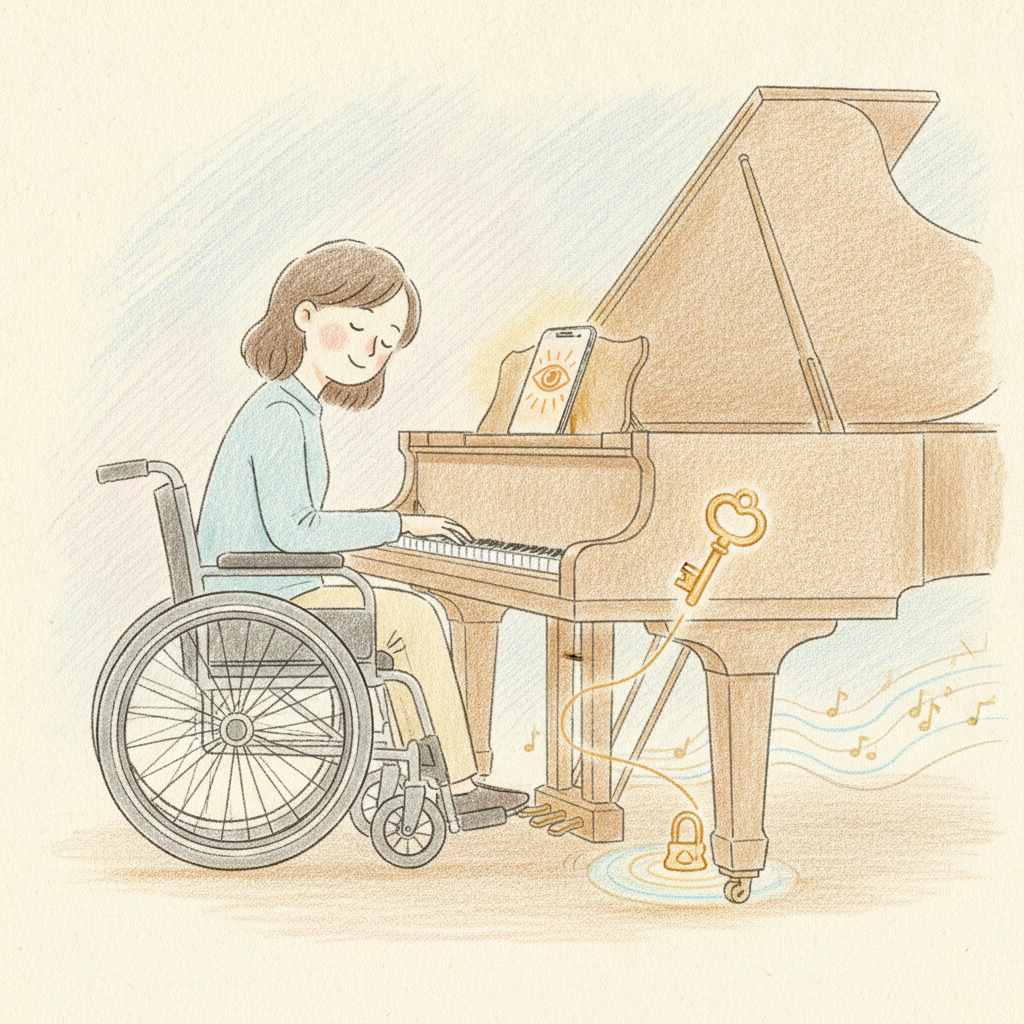
What is an “airback”? — a coined term, not “airbag”
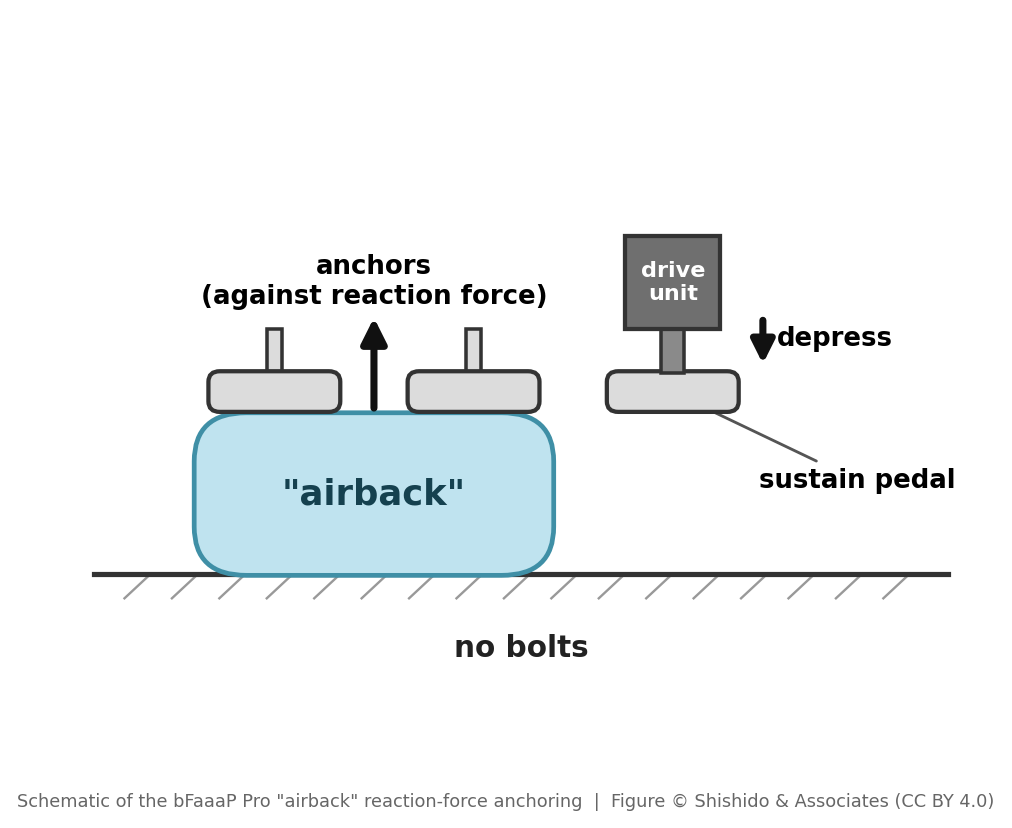
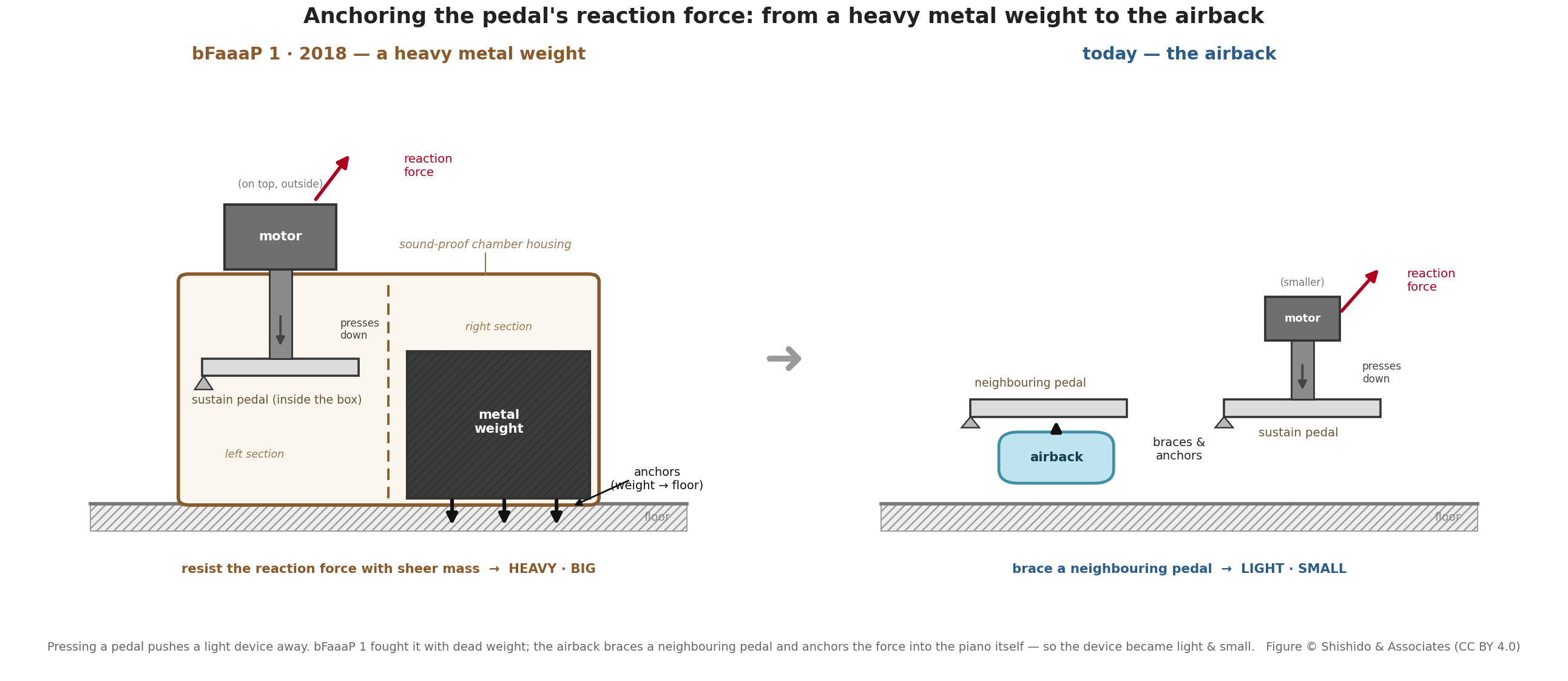
The Pro’s “airback” is bFaaaP’s inflatable, air-braced anchor — not an “airbag”. An air cushion (a WINBAG air jack, inflated by a small electric pump inside the device through an air tube) inflates under a neighbouring pedal and absorbs the actuator’s reaction force, so the device stays firmly in place on an unmodified acoustic piano: no bolts, non-destructive, and quick to set up and remove. The name joins air + back (to brace / support), emphasising anchoring rather than the safety meaning of “airbag”.
The control law, precisely (paper Figures 3 & 4)
Figure 3: above your neutral offset the head angle maps linearly to the pedal value (0–99), scaled by your multiplier and clamped at full; engage and release use a small hysteresis dead-band so the pedal never chatters. Figure 4: prior art was a binary on/off head switch (dashed step); bFaaaP sends a continuous, proportional command whose dead-zone (offset 3–10°) and slope (multiplier 10–50) each player presets — the quantitative, user-tunable law the patents were granted on. (Figures in English.)
Does it really work? The APEE study
Does pressing the pedal with your head really give the rich, sustained sound of a foot on the pedal? We ran a human-subject study — the Auxiliary Pedal Effect Evaluation (APEE) — with 15 participants: adults, children whose feet don’t reach the pedals, and people with disabilities.
How we measured it
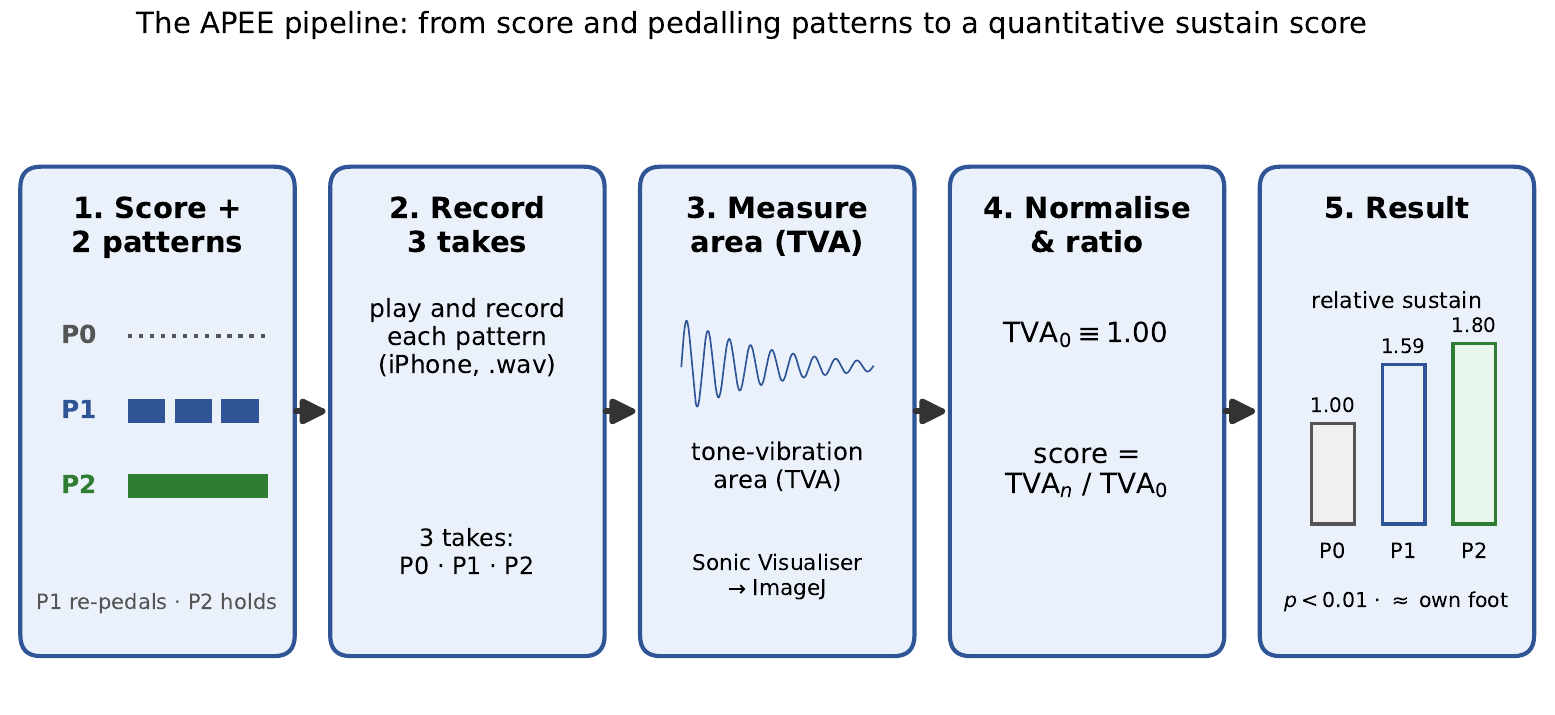
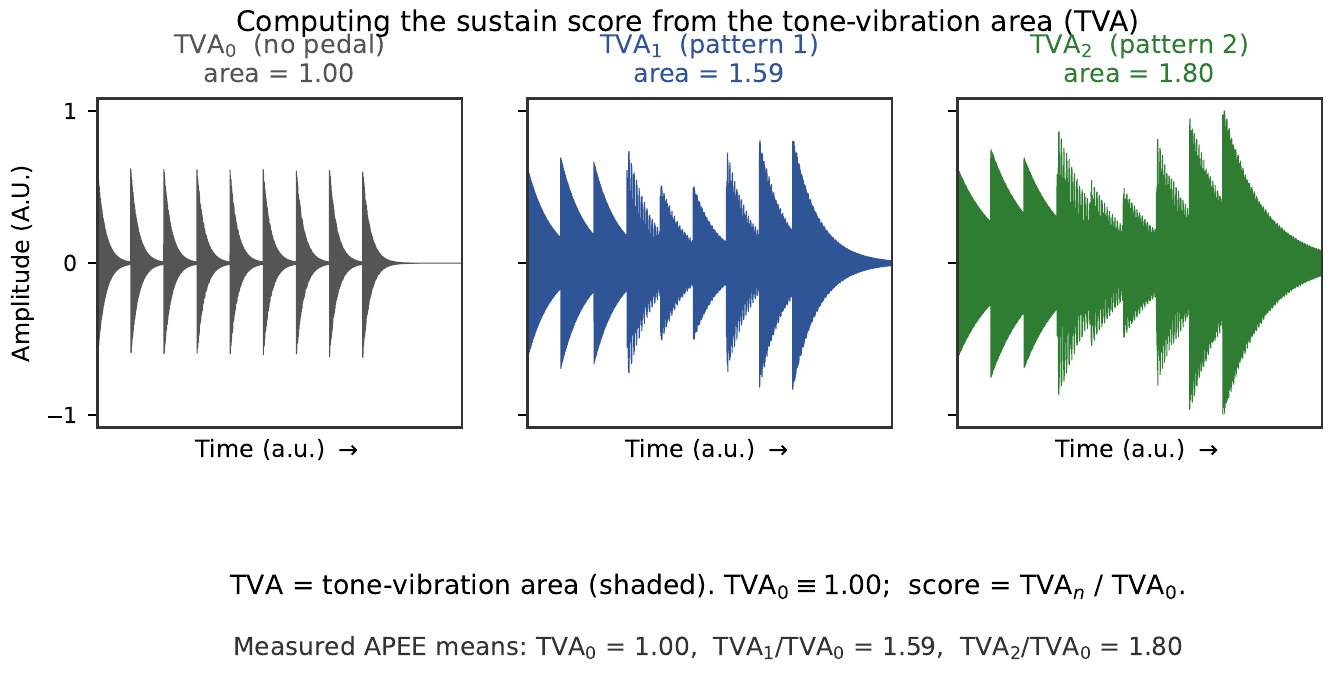
Each participant played the same short motif three ways — no pedal, bFaaaP pattern 1 (re-pedal each three-note group) and pattern 2 (held across groups) — and we recorded each take. We measured the tone-vibration area (TVA), the shaded area of the waveform, and normalized every recording to its own no-pedal take (TVA0 ≡ 1.00). Sustain score = TVAn / TVA0. (Figures in English.)
What we found
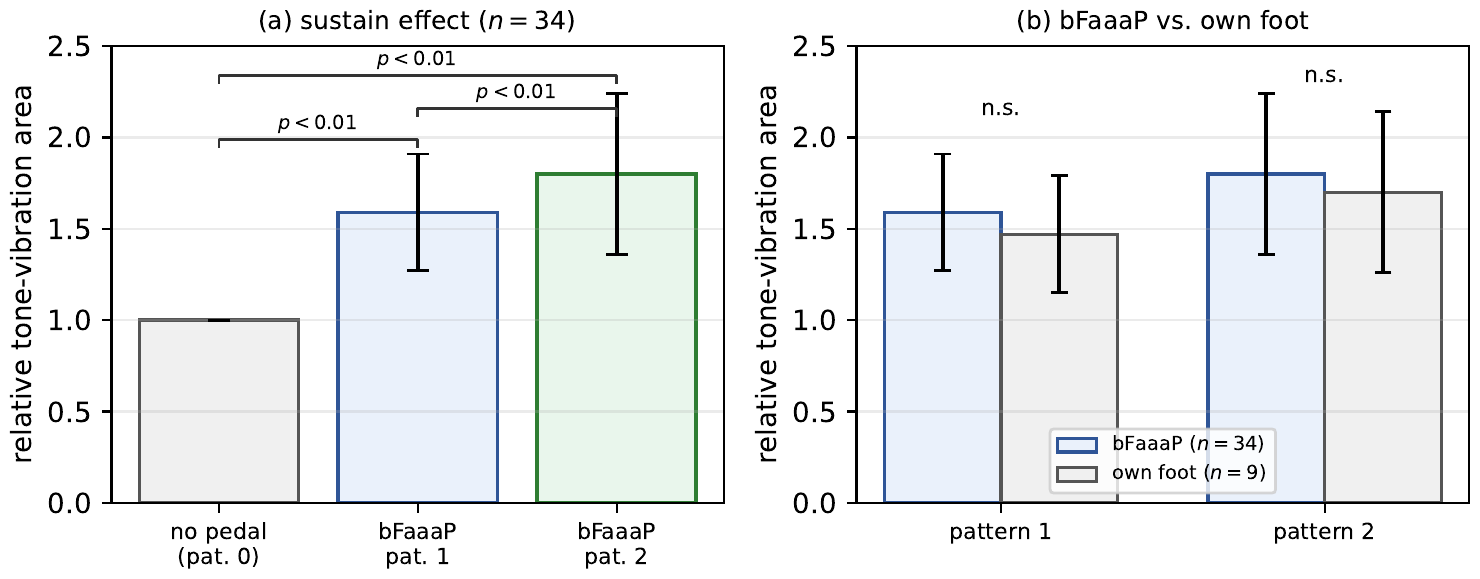
- bFaaaP significantly increases sustained-tone energy — both patterns beat no pedal (p < 0.01).
- It is statistically indistinguishable from the player’s own foot (p > 0.05, “n.s.”).
- No significant difference across participant classes. One participant with a leg disability and a tracheostomy performed successfully, using a small offset with a large multiplier.
The full anonymized data (Appendix A)
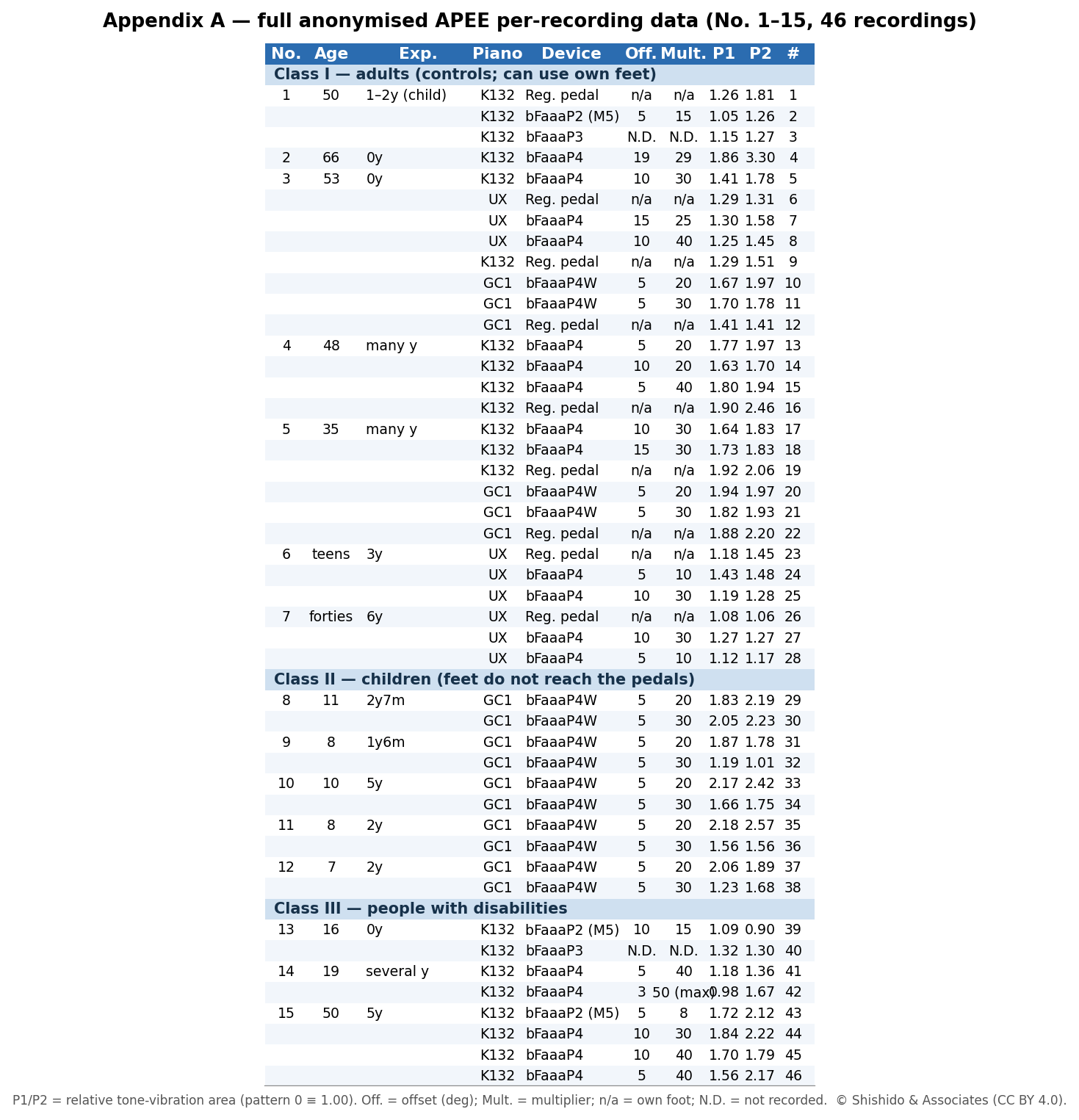
All 46 recordings. Participants are anonymized as No. 1–15, with each player’s chosen offset and multiplier and the relative sustain of patterns 1 and 2.
Ethics & consent
Participation was voluntary, and written informed consent was obtained for every participant: adults consented themselves; the children signed after a parent or guardian confirmed consent through their piano teacher; and participants with disabilities took part with a parent or guardian’s consent, who also accompanied them. No formal ethics-board (IRB) approval was available, but the study followed the ACM policy on research with human participants, and all data are anonymized. Read the ethics & consent details on GitHub →
The controller as a reusable accessibility input
bFaaaP’s smartphone controller (a quantitative, user-tunable head-angle channel on commodity hardware) is the most reusable part. The same controller already drives two actuators (a motor on the Pro, an electronic switch on the Switch), and the device-controller method is patented independently of the pedal, covering “any device.”
- Foot-free — it doesn’t need the lower limbs that wheelchair users often can’t use.
- Nothing on the face or head — the phone sits on a stand (important with a tracheostomy).
- Tunable to a restricted range of motion — a small offset with a large multiplier lets a few degrees of head movement span the full output.
Because the head-angle signal is a continuous, proportional value (not a single on/off switch), it is a general accessibility-control primitive: the same channel could meter other graded controls (environmental control, a communication-aid scan rate, a powered-device level). We present this as future work — bFaaaP is validated for piano pedalling; broader assistive control is not yet validated.
These populations are large and worldwide. The figures below come from heterogeneous surveys and are not strictly comparable (they convey scale, not a ranking; WHO gives only a single global wheelchair estimate).
Table 1: Wheelchair users (or people who need a wheelchair), by region
| Region | Estimate | Source |
|---|---|---|
| World | ~80 million (~1%) need a wheelchair | WHO |
| USA | 3.6 million users (1.5%, 15+), 2010 | US Census |
| UK (England) | ~1.2 million users (est.), 2017 | NHS England |
| Canada | 288,800 wheelchair/scooter users (~1%), 2012 | Smith et al. |
| Japan | ~818,000 manual wheelchairs in use (~0.6%), 2019 | Shirogane et al. |
| Australia | ~119,000 manual users (65+); 679,000 mobility-aid users, 2018 | AIHW/ABS |
Table 2: Home mechanical ventilation (HMV) & invasive subset, by country
| Country | HMV | Invasive | /100k | Source |
|---|---|---|---|---|
| Japan | ~21,000 | 7,700 (TPPV) | — | MHLW 2020 |
| Europe (16) | 21,526 | varies | 6.6 | Eurovent 2005 |
| Canada | 4,334 | ~18% | 12.9 | Rose 2015 |
| Poland | 12,616 | — | 2.8→20 | JCM 2022 |
| Hungary | 384 | 40 (10.4%) | 3.9 | BMC 2018 |
| South Korea | — | 62.8% trach. | 9.3 | Resp. Care 2019 |
| Germany | ~17,000/yr* | ~6% | — | Dtsch. Ärztebl. 2021 |
| USA | no registry | — | — | Mehta 2015 |
Metrics differ and are not strictly comparable. *inpatient episodes/year; the USA has no national home-ventilation registry.
Cited works
Verified June 2026. Full list and saved copies are in the open-source repository (GitHub).
- WHO. WHO releases new wheelchair provision guidelines. 2023. link
- WHO & UNICEF. Global Report on Assistive Technology. 2022. link
- Brault M. Americans With Disabilities: 2010. US Census Bureau P70-131, 2012. link
- NHS England. Wheelchair services. link
- Smith EM, et al. Prevalence of Wheelchair and Scooter Use Among Community-Dwelling Canadians. Phys Ther 96(8):1135, 2016. link
- Shirogane S, et al. Provision of public funding for wheelchairs… in Japan. J Phys Ther Sci 31(2):122, 2019. link
- AIHW. People with disability in Australia (ABS SDAC 2018). link
- MHLW (Japan). Nationwide home mechanical-ventilation survey (2020). link
- Lloyd-Owen SJ, et al. Patterns of home mechanical ventilation use in Europe (Eurovent). Eur Respir J 25(6):1025, 2005. link
- Rose L, et al. Home Mechanical Ventilation in Canada: A National Survey. Respir Care 60(5):695, 2015. link
- Czajkowska-Malinowska M, et al. Home Mechanical Ventilation in Poland 2009–2019. J Clin Med 11(8):2098, 2022. link
- Valkó L, et al. National survey: home mechanical ventilation in Hungary. BMC Pulm Med 18:190, 2018. link
- Kim H-I, et al. Home Mechanical Ventilation Use in South Korea. Respir Care 64(5):528, 2019. link
- Schwarz SB, et al. Inpatient Initiation and Follow-up of Home Mechanical Ventilation in Germany. Dtsch Arztebl Int 118(23):403, 2021. link
- Mehta AB, et al. Trends in Tracheostomy for Ventilated Patients in the US, 1993–2012. Am J Respir Crit Care Med 192(4):446, 2015. link
- bFaaaP device-controller patent JP 7004771 B2 (covers “any device”). link
Where it began — bFaaaP 1 (2018)
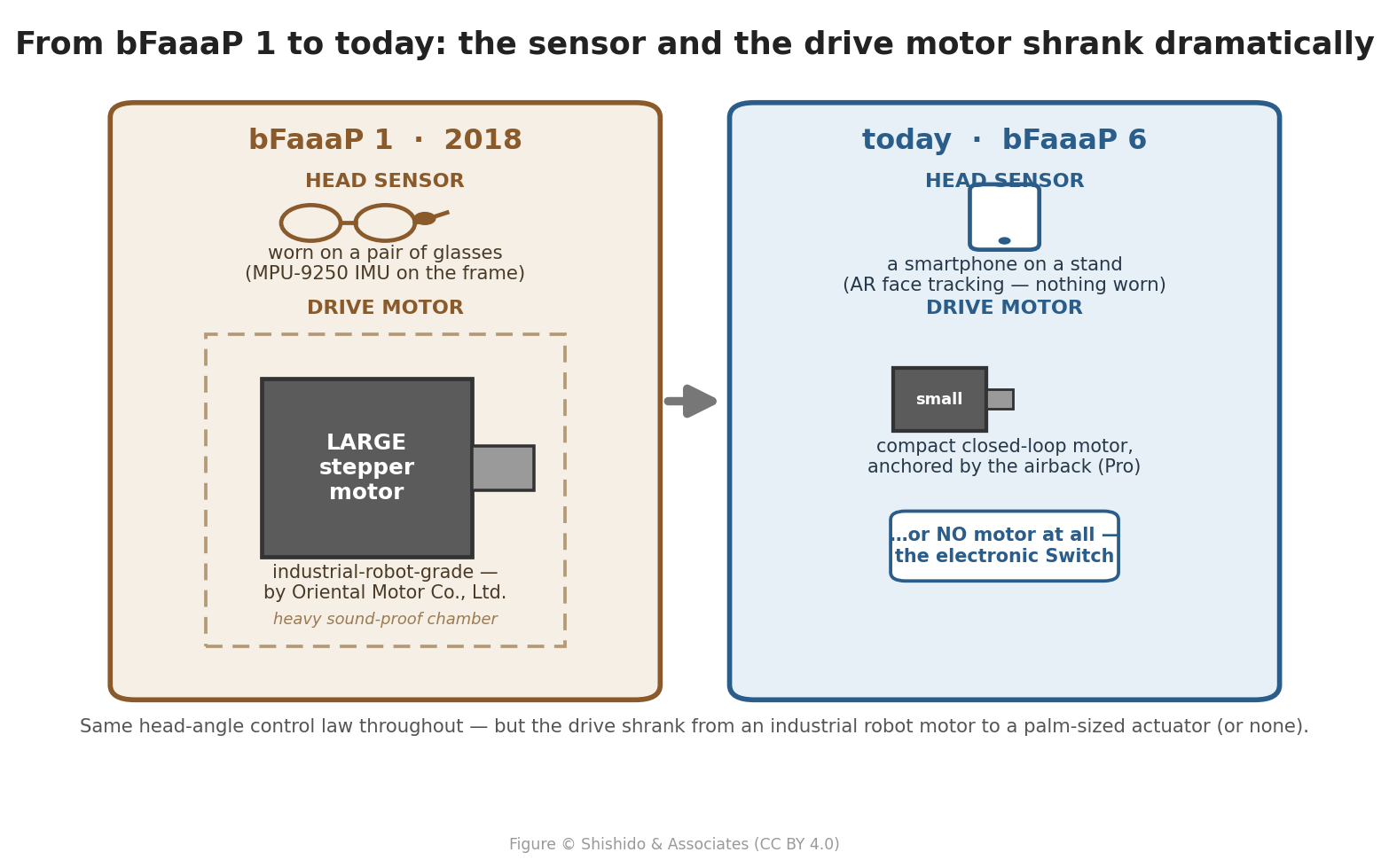
The very first prototype already held the invention: the same head-angle control law (offset + multiplier) drives the pedal today. Only the engineering shrank dramatically.
- Sensor: a head-angle sensor worn on glasses (design-registered) → today a smartphone, with nothing worn.
- Drive motor: a large stepper motor by Oriental Motor Co., Ltd. → a palm-sized closed-loop motor (Pro), or no motor at all (Switch).
- Anchoring: metal weight packed into a bottom compartment of a sound-proof chamber → the pneumatic airback, bracing against a neighbouring pedal.
Performances & demonstrations
Years of recitals, science-fair demos and how-to guides — many performed by players who use bFaaaP every day. Full channel on YouTube.
Concerts & recitals
At a seven-university joint concert (Toyosu Civic Hall, Sept 5, 2022), members of Tokyo Tech’s Platanus ensemble performed Gustav Lange’s “Blumenlied” (Flower Song, Op. 39) using bFaaaP — a piece whose flowing lines lean heavily on the sustain pedal, here played hands-free by head motion.
A full concert on a grand piano with bFaaaP Pro; includes a live device setup walkthrough at 25:01. The best single video to understand the Pro line end to end.
System intro, the members, and three pieces on an electric piano with bFaaaP Switch, followed by a hands-on workshop.
A polished performance showcasing head-controlled sustain in a live setting.
bFaaaP Pro in a concert-hall recital setting.
Setup & user manual
Step-by-step: align the drive over the sustain pedal, anchor with the air-jack, set the travel limits.
The official operating video: connect to the sustain jack, pick the channel, set on/off type and the head-angle threshold.
A longer walkthrough of how the whole system works, from head tracking to pedal.
Voices & exhibitions
The hardware
Pro uses an Adafruit ItsyBitsy nRF52840 Express (BLE) with a Raspberry Pi Pico (RP2040), an IQ servo motor driving a 2GT belt → T10 lead-screw → push-rod on an aluminium-extrusion frame, plus an air-jack anchoring kit and pressure sensing. Switch is just the nRF52840 board driving a relay / opto-isolator into the sustain jack. The repository documents parts, wiring/KiCad schematics, firmware and assembly so you can reproduce or adapt it.
Licensing & patents
| Layer | License | Covers |
|---|---|---|
| Software | Apache-2.0 | iOS app & firmware (with patent grant) |
| Hardware | CERN-OHL-W-2.0 | Schematics, board, mechanical parts |
| Documentation | CC-BY-4.0 | Guides, text, figures |
The control method is patented (JP 6726319 — assist-pedal system; JP 7004771 — head-angle controller; PCT WO2019/176164). Crucially, for genuinely public and inclusive uses — including paid products or services that help people with disabilities participate more fully — bFaaaP patent licensing is granted free of charge as a matter of policy. If that applies to you, contact Tomoyuki Shishido via bfaaap.com.